Loop Reset
Arcade | Twin Stick Shooter | Sci-Fi
A twin stick shooter with arcade feeling, procedural level generation, and upgradable weapons.

Summary
Loop reset is a roguelike twin-stick shooter with an arcade feel and a sci-fi theme. I primarily worked on the level generator, working with the level designer to have cohesive, playable levels. Other responsibilities were game saving, performance handling, game setup sequences, and making builds of the game. After the problems faced because of technical debt, I learned the importance of planning code bases that will be used and how systems would need to scale.
Project Info
Team Size: 5
Project Duration: 4 weeks
Engine: Unreal 5
Roles: System programmer
Other Tools: Perforce, Miro, Jira
Introduction
Loop reset is a rogue-like, twin stick shooter where the player needs to survive a horde of aliens and continually move forward through procedurally generated levels. By using weapons, gadgets, and elemental effects, the player defeats enemies who are constantly getting stronger. Levels can have special objectives that impose challenges that need to be conquered before moving forward.
On this project, my prime responsibilities were level generation - working closely with the project's level designers to make levels feel natural and have a good gameplay flow, both having intense sections and calmer sections.
Other responsibilities I had were: Game saving - handling save data that is being used between levels, for example, weapon upgrades, player current stats, etc. This also included saving to files and handling high scores.
Performance handler - making sure that the performance of the game is good and doesn't go lower than an acceptable level, fixing areas where performance is noticeably worse than others. Changing Unreal settings to exclude features that were not needed or used.
Game setup sequence - controlling how the game loads its level, making sure systems are done initialising before moving to the main gameplay level. This is to prevent game-breaking bugs, for example, levels not being loaded, making it impossible to progress.
Making builds - I was in charge of making builds and making sure that they worked as intended.
Level Generation
In Loop Reset, we have procedural level generation, which uses rooms that have level instances attached to them that get placed in the world one after another, in the end creating a level. Rooms have different sizes and different purposes. For example, a combat room is usually bigger and holds a lot more enemies and is designed to be more intense, while a corridor room is smaller in size and is designed to be calmer. I worked closely with level designers, mapping out how rooms would be placed and what a whole level would look like. The flow of levels was important to consider when building the level generator, having sections with high intensity but also areas that are calmer just after an intense moment. We worked back and forth, having a lot of conversations about what was wanted from the level generator and what was needed. Throughout the project, I controlled the production flow for rooms, keeping track of what type of rooms were needed and setting deadlines for them. This was so that rooms were done in a reasonable time, and also so rooms were not over-scoped and would work with the level generator.
What is a room
A Room is an Actor that holds the size of the room in the form of a collider, and the direction of it, including an entering point and exit points. All meshes and any special mechanics that are connected to a room are kept in a level instance that gets loaded in when the level generator can confirm that it has finished making a level.
Before spawning
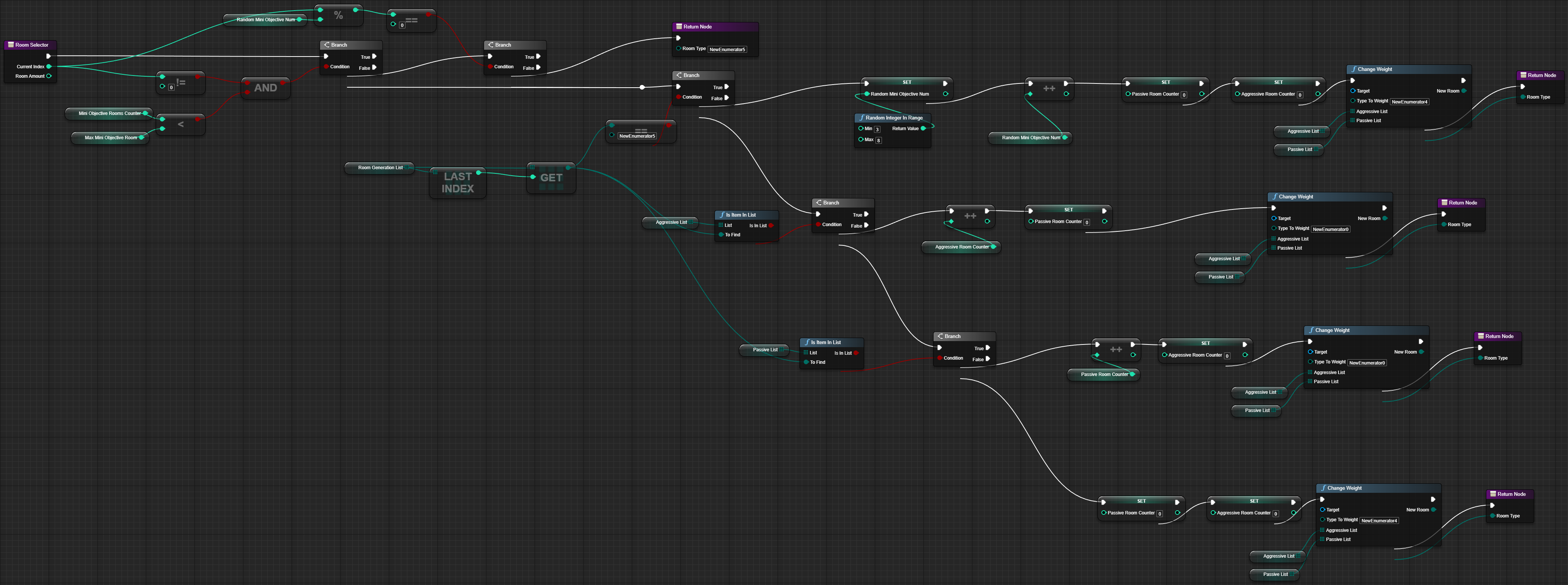
How the level generator works is first choosing which order rooms will spawn in, with some weighted randomness, a room type gets chosen - a room type being an Enum class. The chosen room type gets placed in an array that's going to be used later for spawning room Actors. The weighted randomness gives control over level flow when generating.
Room spawning
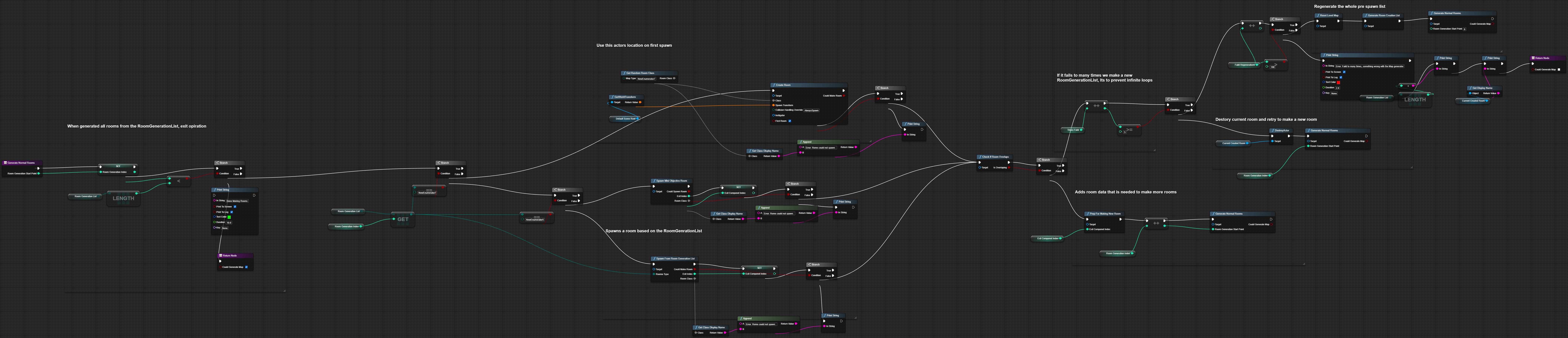
When generating rooms, the generator goes through the room type array that was generated beforehand, spawning rooms that are correlated to the room type and placing them on the edge of any exit points from the previous room. When a room spawns, we check if it collides with other rooms to make sure that rooms aren't overlapping. If the recently spawned room collides with another room, we delete the spawned room and try again with another room piece. If a room piece is valid, we collect any exit points from the room, they get used for the next spawning room. The generator continually repeats these actions, going through the room type array until it's empty.
Special rooms spawning
Special rooms are single offshoot rooms that can be connected to normal rooms that have exit points to hold them. They hold different events that are contained and designed to promote exploration. To make sure that special rooms do not interfere with the normal room spawning, they are done after the normal spawning is complete. Spawning works the same as the “Room spawning” section, but with the added caveat that if a special room spawns and it collides with another room, the spawned room gets removed and gets replaced with a wall, closing the possibility of moving that direction.
When every room is placed and the map is done generating, without failing, we load all level instances for the rooms and wait for them to load before completing the level generator. We use level instances to save on loading times, only loading assets when we have a working level, and to make it easier for the level designer to make levels, not being restricted by building them in blueprints.


Challenges
When making the level generator, it was easy to make rooms spawn and check if placements were valid. I struggled with figuring out how to control the randomisation with the system I had, because the world map isn't built on a grid, and rooms don't have any standardized measurements. We also wanted the map to be linear, having a clear direction to move and no big branching paths that the player could walk through. Why we wanted control over how levels were generated was to get control over the game and level flow, having areas that are intense and calmer areas.
The solution to have control over the generation was to have an Enum array of room types, which gets filled by weighted randomisation. By categorizing room types into two groups: Aggressive rooms - larger rooms with combat, and passive rooms, and passive rooms - calmer sections where almost no combat happens, I could then track how the level flow would be. By tracking which group the latest room type belonged to, I could weigh the choice for the level selector. For example, if the generator had added two passive room types, for the next room it could choose, there were 80% chances for an aggressive room to spawn, instead of the default 40%. This worked the same if there were multiple aggressive room types that were spawned, but with different percentile values. This gave more control over the generation, so there were no long stretches of the level where nothing happened or too much happened.
What I learned
In this project, I had a great team and working environment, and we were driven throughout the project. We did have problems with technical debt; the code base at the beginning of the project was not the best, making it hard to work with. Debugging and bugfixing were particularly difficult; on many occasions, values that would be used to change stats didn't work as intended, which made it hard to find and fix problems inside the code base.
Fixing the code base at the beginning of the project would save a lot of time and work for all involved in the project. Code that worked at the beginning was never really future-proofed or planned to be expanded on, which caused problems later on when it needed to be expanded. With the short period of the project, we didn’t have time to fix problematic portions of the code base. If the code didn't have critical problems, it was kept and not changed, which made technical debt problematic. From this situation, I learned the importance of planning out the code bases before committing to writing it, and the importance of planning how a system would scale when more features are added.
I also learned the importance of having someone in the team who can set deadlines for content; in this project, it was partly my role. Because of the limited time of the project, we needed internal deadlines for features and content pieces to make sure that we had the time to make everything that we wanted to be in the game. With the deadlines, we could plan better for what was possible with the time we had, making the work experience more enjoyable with less stress through the project.